Epithelia are often subject to friction and wear due to mechanical forces. These phenomena are even more common in stratified squamous epithelia due to the position they occupy in the skin and in some mucous membranes.
As shown previously most epithelia, and especially stratified squamous epithelia, undergo a replacement of cells that detach at its surfaces. In stratified squamous epithelia, the cells of the basal layer are less differentiated and divide continuously. The arrows in the image indicate mitotic cells in the basal layer of the epithelium.
The daughter cells resulting from divisions have two fates: a) they remain in place, serving as source cells for new divisions; b) they progressively migrate to the surface, while synthesizing new types of proteins (undergoing a differentiation process) and modifying their shapes. After detaching off the surface, their loss is compensated by the production of new cells in the basal layer, a process that keeps the total thickness of the epithelium rather constant.
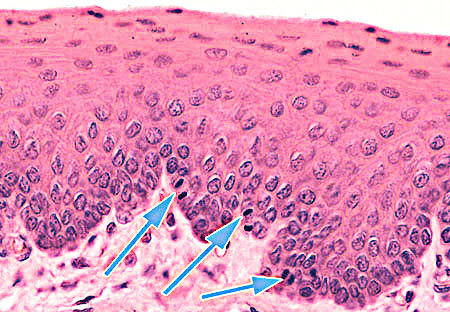
Esophagus. HE staining. Large magnification.